Systems and workflow

Systems and workflow – How work moves, where it waits, and why the same problem keeps returning. Mapping, handoffs, feedback loops and workflow design.

A visual contrast, one half showing a messy, chaotic desk with post-its and pings, the other half showing a calm, clean workspace with a digital workflow system glowing subtly in the background.

Design for the Work You Want, Not the Chaos You Have

Systems-first thinking is essential for small businesses to move from chaos to clarity. Instead of relying on habits, intentional design of workflows is crucial. The process involves mapping current workflows, defining ideal operations, and aligning tools to support these designs. Transitioning from reactive to proactive processes can lead to reduced stress and improved efficiency.

Design for the Work You Want, Not the Chaos You Have Read More »

A bird’s-eye view of a stylised business flowchart being scanned or assessed by a magnifying glass, with check marks and warning symbols along the path — warm, professional, and friendly.

EdgeMap: How to Diagnose Your Workflow Health

Before automating processes, it’s crucial to diagnose existing workflows. EdgeMap serves as a diagnostic tool to uncover bottlenecks, communication gaps, and inefficiencies. Businesses can identify and prioritize fixes to enhance workflow clarity and efficiency. By addressing fundamental issues rather than simply applying technology, companies can achieve better operational performance.

EdgeMap: How to Diagnose Your Workflow Health Read More »

A confident business owner stepping away from their desk at 3pm on a Thursday, while behind them, a clean digital workflow hums along automatically. Bright, energetic colours evoke freedom and control.

How to Win Back 2 Days a Week The Edge151 Philosophy in Practice

5 working days’ output, done in 3. Here’s how we make it possible. Introduction: Escaping the “Always On” Trap If you’ve ever finished a week of work, closed your laptop, and thought “What did I actually achieve?” you’re not alone. For small business owners and managers, time can feel like a cruel joke. You’re busy

How to Win Back 2 Days a Week The Edge151 Philosophy in Practice Read More »

Team working together around a dashboard showing process improvements and support metrics

Case Study: The Business That Didn’t Hire More Staff

The content discusses how a fast-growing tech services company managed a 35% increase in customer support tickets without hiring new staff. By redesigning their workflows, implementing structured feedback loops, and introducing AI tools, they achieved a 22% reduction in ticket volume and improved response times, showcasing the importance of effective processes over hiring.

Case Study: The Business That Didn’t Hire More Staff Read More »

Side-by-side comparison of efficient and inefficient workflows scaling with business growth

Systems Thinking: Are You Scaling the Work or the Waste?

The content emphasizes that business growth can sometimes lead to worsened efficiency due to improperly scaled workflows. It identifies signs of scaling waste and advocates for mapping, fixing friction, and using data to improve systems before expansion. The use of AI is suggested as a means to efficiently manage growth without increasing chaos.

Systems Thinking: Are You Scaling the Work or the Waste? Read More »

Circular feedback loop diagram with arrows connecting input, action, and output stages

Feedback Loops – The Hidden Engine of Improvement

The content emphasizes the importance of feedback loops in business workflows for sustainable growth. Without these loops, organizations face recurring mistakes and missed customer insights. Building effective feedback mechanisms involves fostering communication, automating data collection, creating regular reflection times, and using AI to enhance insights, ultimately leading to smarter scaling and improvement.

Feedback Loops – The Hidden Engine of Improvement Read More »

Hand-drawn workflow map sketched on a whiteboard with labelled steps and arrows

Systems Thinking: Workflow Mapping for Non-Operations People

Many small and mid-sized businesses operate with informal, unrecorded workflows, which can lead to issues when tasks are missed. Mapping these workflows clarifies processes, spots inefficiencies, and facilitates improvements. By following a five-step guide to workflow mapping, organizations can enhance operations and promote growth through visibility and structured analysis.

Systems Thinking: Workflow Mapping for Non-Operations People Read More »

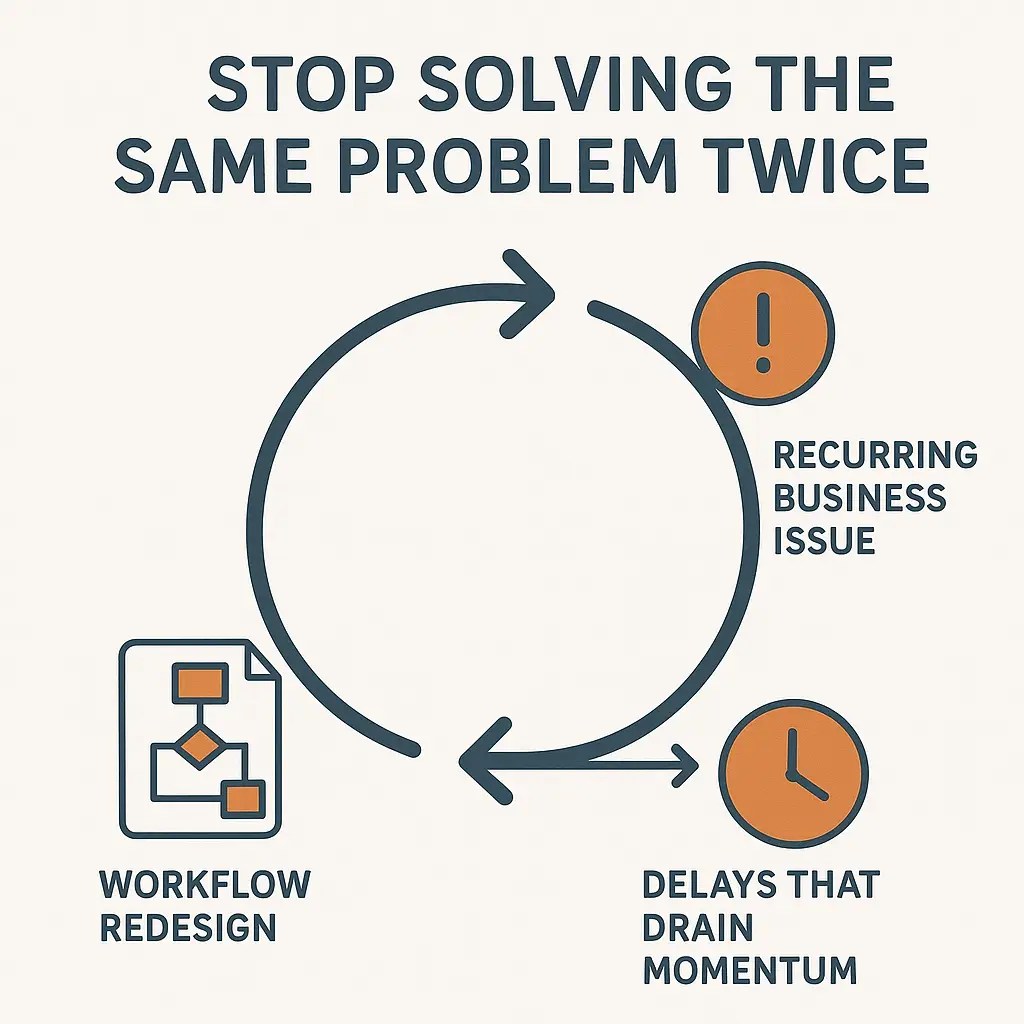
Looping arrow diagram showing a recurring business issue being resolved through workflow redesign

Systems Thinking for SMB’s: Stop Solving the Same Problem Twice

Edge151 addresses recurring business issues rooted in flawed systems rather than individual mistakes. By emphasizing design over reaction, businesses can identify patterns, map workflows, find root causes, and implement lasting solutions that don’t rely on memory or manual efforts. This approach promotes efficiency and reduces team burnout, enhancing overall growth.

Systems Thinking for SMB’s: Stop Solving the Same Problem Twice Read More »

Diagram showing five key leverage points in a business workflow

Systems Thinking Mindset: The 5 Leverage Points Hiding in Your Workflow

To improve business efficiency, small adjustments can yield significant results. Identifying leverage points in workflows—like team handoffs, feedback loops, rigid policies, manual tasks, and delays—can prevent chaos and enhance productivity. Emphasizing workflow design over adding resources allows businesses to maximize their impact and achieve better outcomes.

Systems Thinking Mindset: The 5 Leverage Points Hiding in Your Workflow Read More »

Illustration of a connected workflow system representing systems thinking in business

Systems Thinking – The Mindset for Smarter, Leaner Business

Effective problem-solving in business requires understanding underlying issues rather than merely addressing symptoms. Systems thinking promotes viewing a business as interconnected parts, enabling leaders to identify patterns and leverage points to create lasting solutions. This approach is crucial for small and mid-sized businesses to eliminate inefficiencies and enhance workflows sustainably.

Systems Thinking – The Mindset for Smarter, Leaner Business Read More »

Scroll to Top